
intent-engineering
intent-engineering is an MCP server that exposes three tools — audit_intent_spec, generate_intent_spec_scaffold, and assess_retrofit_level — letting any MCP-aware client (Claude Desktop, Cursor, Anti-Gravity) review, scaffold, and triage agent intent specs against a 9-section unified template synthesized from production-agent research.
Most agent failures aren't reasoning failures — they're intent failures. The spec is vague, the stop rules are missing, the outcome is an activity disguised as a state. This server makes that gap auditable from inside the harness the agent already runs in. The full reasoning, the rejected alternatives, and what would break in v0 live in docs/EXPLANATION.md.
Why this exists
Problem
Engineering teams treat AI agents like reliable coworkers, but agents fail silently when given underspecified intent. The cost is shipped features that solve the wrong problem — and the failure mode is invisible until production. PMs feel this pain twice: once writing the spec, and again when an agent confidently delivers something off-target. There's no shared protocol for "audit this spec before an agent runs on it."
Solution
A Model Context Protocol server that exposes three tools any MCP-aware client (Claude Desktop, Cursor, etc.) can call: audit_intent_spec audits a spec against a 25-item rubric, generate_intent_spec_scaffold scaffolds new specs by kind, assess_retrofit_level retrofits older docs. Published to npm as @swins/intent-engineering-mcp and to the official MCP registry as com.seanwinslow/intent-engineering via DNS-verified namespace.
Tradeoffs and Decisions
- TypeScript over Python: the MCP TS SDK has the deepest client coverage (Claude Desktop, Cursor) — at the cost of locking out the Python-native data science crowd.
- stdio transport over HTTP: zero-infra v0, but couples the server to a process-bound client. v1 will add SSE for cloud agents.
- DNS-verified namespace (
com.seanwinslow/*) over GitHub-handle namespace: locks the brand surface to a domain I control; required a separate Ed25519 keypair + apex TXT record, which is more upfront friction thanmcp-publisher login github.
What I Learned
The MCP protocol is essentially a contract for "I am a tool an LLM can call without me writing a wrapper." Once that landed, the server became a thin protocol adapter over an existing skill — and the OPTIONAL-fields pattern I'd developed on a separate knowledge-graph project translated directly. The most non-obvious win: the server scored 23/25 with zero anti-patterns when audited by its own tool. A tool that successfully eats its own dog food earns more credibility in 30 seconds of demo than 30 minutes of documentation.
Three tools
| Tool | Input | Output |
|---|---|---|
audit_intent_spec | A spec (spec_text or file_path) | Score out of 25, per-section findings, detected anti-patterns, top 3 recommendations |
generate_intent_spec_scaffold | kind (blank / level-1-mvr / full-9-section), optional hints | A paste-ready YAML scaffold + next-step actions |
assess_retrofit_level | An existing prompt or SKILL.md | Recommended retrofit level (L1 / L2 / L3) with blast-radius + complexity + autonomy reasoning |
The 25-item validation checklist, 5 fatal anti-patterns, 4 autonomy levels, and 9-section template all come from the canonical intent-engineering skill. The MCP server is a thin protocol adapter, not a fork.
Quickstart
Requires Node 20+ and an MCP-aware client (Claude Desktop, Cursor, etc.).
git clone https://github.com/seanwinslow28/sw-mcp-intent-engineering.git
cd sw-mcp-intent-engineering
npm install
npm run build
Then add the server to your Claude Desktop config at ~/Library/Application Support/Claude/claude_desktop_config.json:
{
  "mcpServers": {
    "intent-engineering": {
      "command": "node",
      "args": ["<ABSOLUTE_PATH_TO_REPO>/build/index.js"]
    }
  }
}
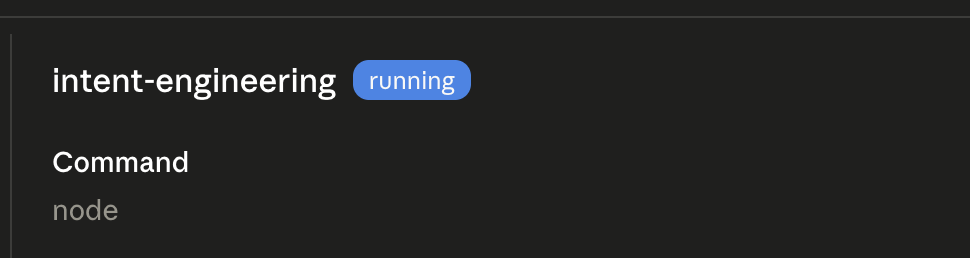
Restart Claude Desktop. Open Settings → Developer to confirm the server shows as running:
The three tools then appear in the tool list under intent-engineering in any new conversation.
Try it
Paste this into Claude Desktop after the server is connected:
Run
audit_intent_specon this spec:## Objective Make support tickets resolve faster. ## Outcomes - Tickets close in <2h - CSAT stays high ## Stop Rules (none)
You'll get back a score out of 25, a list of detected anti-patterns (this spec hits at least three), and three concrete recommendations to fix it. The full I/O contract lives in docs/v0-scope.md §4.
Dogfood result
The canonical intent-engineering SKILL.md, audited by its own MCP server, scores 23/25 with zero anti-patterns detected. Seven sections pass cleanly; two return warnings (outcome measurability and a health-metric behavioral-adjustment phrasing). The tool eats its own dog food and the dog food is mostly nutritious.
At scale: the same server audited all 118 first-party skills in my Claude Code Superuser Pack in under a second. 24% scored L1-mvr (the spec just needs an intent header), 36% scored L2-structured (needs Health Metrics + Decision Authority), and 40% scored L3-full (autonomous-loop or high-blast-radius skills that warrant a 9-section conversion). Zero parse errors across the batch. The full CSV is at examples/superuser-pack-retrofit-assessment.csv.
Limitations
The audit is opinionated about heading structure, but it now recognizes a conservative set of alias headings in addition to the canonical ones — ## Purpose / ## When to Use map to Objective, ## Success Criteria / ## Definition of Done to Desired Outcomes, ## Completion / ## Exit Criteria to Stop Rules, and so on (the full table lives in src/intent/parser.ts). When a section is recognized from a non-canonical heading the audit says so in its notes, so the score stays legible. Earlier, skills using different heading vocabularies scored 1/25 because none of their present sections were recognized; that false-negative is fixed. Two honest boundaries remain: headings that are not true intent equivalents (procedural ones like ## How to Apply, ## Instructions, ## Usage) are deliberately left unmapped rather than credited to the wrong section, and a spec that genuinely lacks the nine intent sections still scores low — the mapper recognizes equivalent intent, it does not invent it.
Other v0 boundaries worth naming up front:
- Read-only. No tool writes files.
assess_retrofit_levelrecommends; it does not retrofit. A v0.2apply_retrofitwould live behind explicit user confirmation. - Stdio transport only. No Streamable HTTP, no SSE, no remote hosting. Run it locally next to your client.
- No
promptsorresourcesprimitives. Three tools and that's it. Adding more before the surface is stable would be premature.
Project layout
sw-mcp-intent-engineering/
├── src/
│   ├── index.ts                    # MCP server boot + tool registration
│   └── intent/
│       ├── audit.ts                # audit_intent_spec logic
│       ├── scaffold.ts             # generate_intent_spec_scaffold logic
│       ├── retrofit.ts             # assess_retrofit_level logic
│       ├── checklist.ts            # 25-item validation checklist
│       ├── anti-patterns.ts        # 5 fatal anti-pattern detectors
│       ├── parser.ts               # YAML frontmatter + markdown heading parser
│       └── templates/              # YAML scaffolds (blank / level-1-mvr / full-9-section)
├── docs/
│   ├── v0-scope.md                 # binding scope-lock for v0
│   ├── EXPLANATION.md              # 4Q comprehension artifact (why MCP, what would break, what I learned)
│   └── claude-code-responses-and-tests/   # archived phase-verification outputs
├── package.json
├── tsconfig.json
├── server.json                     # registry metadata
├── CHANGELOG.md
├── README.md
└── LICENSE
src/index.ts is a thin protocol adapter. All tool logic lives in src/intent/*.
Build discipline
- SDK pinned at
@modelcontextprotocol/sdk@1.29.0(stable v1.x line, not the v2 pre-alpha) - All logging goes to
console.error. AprepublishOnlygrep guard fails the build if anyconsole.logappears insrc/ - Tool implementations import the validation checklist, anti-pattern definitions, and template strings from local modules that mirror the skill. They do not paraphrase or reinvent skill content
- Scope changes require explicit approval in
CHANGELOG.mdbefore code is written
Further reading
docs/EXPLANATION.md— the 4Q comprehension artifact (what this is, why this approach, what would break, what I learned)docs/v0-scope.md— binding v0 scope-lock and ship gate- seanwinslow.com/transactions/intent-engineering-mcp — deep-dive write-up with Loom demo
License
MIT. See LICENSE.